Friday, October 29, 2010

The Defenders Elvis Episode Based On True Story!
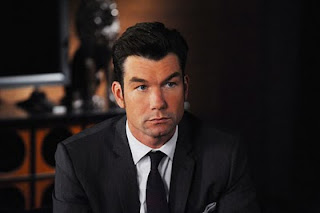
Pete (Jerry O'Connell) tries to cut a deal for man caught with stolen Elvis memorabilia
The handsome Jerry O'Connell and Jim Belushi ( brother of the comedian, John Belushi) star in a new drama on CBS called The Defenders. Episode 6 which aired this week was based on a true story with an Elvis connection. It's easy enough to like Jerry O'Connell for his striking good looks, but now his character plays a die hard Elvis fan.

Eposide Recap:
An Elvis impersonator attempts to rob the Elvis museum and Pete takes the case. Nick defends a young man on an armed robbery charge when he finds out he was only the get away driver. Pete hears that the famous Elvis O Rama museum has been hit in Vegas. He goes crazy because he is a huge Elvis fan. He ends up getting handed the case by the Public defender's office, and takes it with glee. The man who committed the robbery was a small town guy -- not too bright, who needed some extra money to pay the rent back home. He thought he could pull off the heist, and then sell the jewelry to some other Elvis impersonators, but the other Elvis impersonators sold him down the river out of loyalty to the King. Nick and Pete take on a case where a young man got caught up with the wrong group of guys. He agreed to drive them to a bar where they were getting payment for a gambling debt. Once inside the bar, the guys started shooting, and not only that, it was a cop bar. A cop was shot, and now the young man who was just a driver, is being held for felony murder and grand larceny charges. Nick is friends with this guy’s father, who is doing everything he can to protect his boy from these trumped up charges. Nick helps them get the charges dismissed, and prove that there was jury tampering by the police force.


Elvis A Rama:
This eposide is based on the true story of the robbery which occured in 2004 at the Elvis A Rama Museum in Las Vegas owned by well known Elvis collector, Chris Davidson. The museum opened on November 5, 1999, and showcased more than $5,000,000 worth of Elvis' vehicles, jumpsuits, guitars and other memorabilia. The museum was housed in an 8,200 sq ft  building that contained the museum, 100 person showroom and extensive gift shop. A break-in occurred at the museum on March, 17, 2004 with almost $300,000 worth of memorabilia stolen including Elvis' jewelry and a .38 special handgun. The stolen items were recovered on November 03, 2005 with the assistance of Duke Adams, an Elvis impersonator who was approached by, Eliab Aguilar, who was subsequently arrested by Las Vegas Metro for the robbery. The museum was located at 3401 Industrial Road, Las Vegas, Nevada.
Elvis Presley Enterprises, Inc acquired the assets and trademark to the museum and closed it on October 1, 2006 to make way for a world class Elvis attraction on the Las Vegas strip. CKX, Inc. granted Mr. Davidson the right to open a museum in Hawaii. Neither place has opened yet.
If you missed this eposide, you can watch the full eposide using this link:

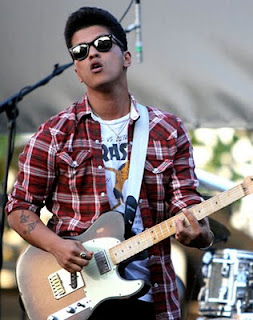
Remember Little Bruno , The youngest ETA?

Well, look at him now. He's all grown up and still performing. Bruno stole the hearts of many fans in the early 90's performing in Memphis at the legendary Bad Bob Vapor's and at some of Darwin Lamm's tribute concerts. I recently wondered whatever happened to Little Bruno. He brings back great memories of Elvis Week before it became so commercial.
Bruno is now 25 and considered a "pop star". Born Peter Gene Hernandez on October 8, 1985, known by his stage name Bruno Mars, is an American singer-songwriter and music producer. He is known for lending his vocals and co-writing the hooks for the songs "Nothin' on You" by B.o.B, and "Billionaire" by Travie McCoy, as well as his own international number-one single "Just the Way You Are". He also co-wrote the international hits "Right Round" by Flo Rida featuring Kesha, "Wavin' Flag" by K'naan, and "Fuck You!" by Cee Lo Green. On October 4, 2010, he released his debut album, Doo-Wops & Hooligans.
Check out Bruno's # 1 Single, Just The Way You Are
http://www.youtube.com/watch?v=LjhCEhWiKXk

And here's Bruno in his "Elvis" Days:
http://www.youtube.com/watch?v=tdxr0z3SZ74

To learn more about Bruno, visit his web site:
http://www.brunomars.com/

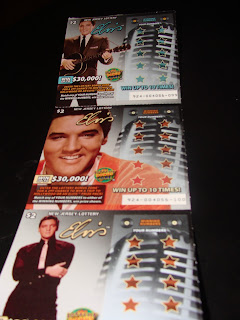
Elvis Scratch Off Lotto Tickets In New Jersey


Available since April, 2010 are these Elvis $2.00 scratch off tickets from the New Jersey State Lottery. They just caught my eye last week and I had to buy them. 1 ticket was a winner!

More Than $6 Million in Prizes!Approximately 5.4 million ELVIS™ tickets are initially planned in this game. The New Jersey Lottery reserves the right to subsequently increase this quantity of tickets. Should additional tickets be introduced, prize levels and frequency of winning will be consistent with the following disclosures:
In ELVIS™ Instant Game, New Jersey allocated 65.00% of the gross receipts to prizes. On the average, better than 1 in 6 wins a prize. Odds and number of winners may vary based on sales, distribution and claims. In a game of 5,400,000 tickets there are 378,000 of $2; 216,000 of $3; 252,000 of $5; 144,000 of $10; 36,000 of $20; 21,330 of $40; 9,810 of $50; 360 of $100; 65 of $500; 4 of $10,000 and 3 of $30,000.

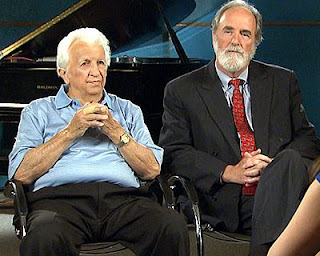
Happy Birthday Dr. Nick!

Today is Elvis' former physican and friend, Dr. Nick's 83rd birthday! Most recently, Dr. Nick's health has suffered some set backs. Let's hope that today is  very special for him and he has a full recovery very soon!
Dr. Nick may all your birthday wishes come true and here's to many more!

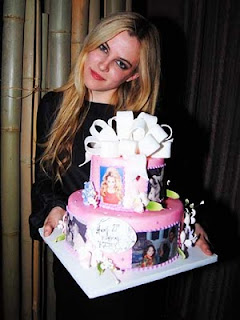
Elvis' Grand Daughter Riley Keough's Mad Max Film Delayed


Mad Max: Fury Road’, the sequel movie for ‘Mad Max’ is once again delayed and is expected to start the filming in 2012. The movie has been delayed because of the date’s conflicts with some of the cast members in the movie.
According to the insiders of project, some of the cast members are unable to return for the movie until August or November next year. So, the filming of the movie is now pushed back to February 2012.
‘Inception’ fame, Tom Hardy will appear in ‘Mad Max: Fury Road’ and he will play one of the key role as Mel Gibson’s role as Max Rockatansky.
Charlize Theron, Nicholas Hoult and Riley Keough are expected to play the remaining lead roles and they will join Hardy in the cast for ‘Mad Max: Fury Road’.

Source: Open

The Jordanaires Attend Country Music Hall of Fame Medallion Ceremony

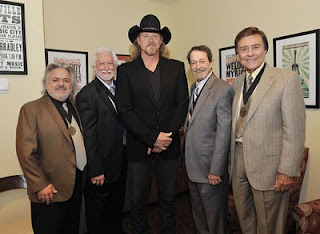
Trace Adkins (center) and the Jordanaires pose for a photo backstage at the Country Music Hall of Fame medallion ceremony in Nashville on Oct. 24, 2010.
Photo Credit: Donn Jones

Don Williams, Jimmy Dean Officially Inducted Into Country Music Hall of Fame
Trace Adkins, Roy Clark, Alison Krauss, Dailey & Vincent, Del McCoury Sing Tributes
The late Jimmy Dean and the ailing Don Williams were officially inducted into the Country Music Hall of Fame Sunday night (Oct. 24) in a ceremony held at Nashville's Country Music Hall of Fame and Museum.
The event is called the medallion ceremony because each inductee is awarded a commemorative medallion.
Dean died in June of this year at age 81, after his election to the Hall of Fame was announced in February. Williams, 71, fell ill with bronchitis on Friday (Oct. 22) while on tour and cancelled his induction appearance.
A measure of the two artists' influence was evident in the variety of artists who came to sing their songs and their praises, a lineup that included Roy Clark, Alison Krauss, Dailey & Vincent, the Del McCoury Band, Trace Adkins, the Jordanaires, Joey & Rory and Chris Young.
Under an overcast sky, guests began arriving for the ceremony at 5 p.m. For the next two hours, they mingled in the Hall of Fame's cavernous Curb Conservatory, sipping cocktails and grazing at the constantly replenished buffet tables. Uniformed waiters circulated with trays of hors d'oeuvres for those disinclined to forage.
Circulating among the guest were Hall of Fame members Bill Anderson, Emmylou Harris, Roy Clark, Harold Bradley, Charlie McCoy, Jim Foglesong, Frances Preston, Jo Walker-Meador and the Jordanaires' Ray Walker.
The formalities, held in the adjacent Ford Theater, began, as is the custom, with the playing of a historic recording from the Bob Pinson Recorded Sound Collection. This year's choice was the Stanley Brothers' 1960 cover of Hank Ballard's R&B gem, "Finger Poppin' Time."
Somewhat puzzled, the crowd reacted to this "rhythm and bluegrass" hybrid with total silence.
Next came Marty Stuart and His Fabulous Superlatives to liven things up with a high-lonesome, high-velocity rendering of the Bill Monroe chestnut, "Working on a Building." After respectfully greeting the dignitaries seated on the front row, the ever-mischievous Stuart added, "I've never in my life seen a bunch that needed a gospel song more than they do."
Talk about sharp-dressed guys! Stuart, on mandolin, was clad completely in black, while his bandsmen -- drummer "Handsome" Harry Stinson, bassist "Apostle" Paul Martin and guitarist "Cousin" Kenny Vaughan -- were resplendent in white suits with black shirts. Stinson's high-tenor vocals set the crowd cheering long before the song was over.
Kyle Young, director of the Country Music Hall of Fame and Museum, deftly handled the master of ceremonies chores, summarizing the personal history and professional evolution of each inductee and interrupting his narrative from time to time to bring another performer to the stage.
He traced Dean's trajectory from being "born into poverty [in Texas] on the eve of the Great Depression" to becoming a recording and television star in the 1950s and '60s to his final incarnation as the creator and purveyor of Jimmy Dean Sausage.
"He took country music, the voice of the working man, to network television," Young asserted, citing his successes both on CBS with a morning show, beginning in 1957, and on ABC in prime time, starting in 1964.
Concurrently, Dean was racking up hit after hit on the Billboard country charts, Young continued. His first, "Bumming Around," a hobo song, came in 1953.
To demonstrate Dean's sunny attitude and easygoing vocal style, Young introduced singer-songwriter Shawn Camp to breeze through, "Bumming Around."
Backing Camp was the Medallion All-Star Band, an assemblage of top-drawer session players that included acoustic guitarist and musical director Biff Watson, drummer Eddie Bayers, steel guitarist Paul Franklin, electric guitarist Steve Gibson, bassist Michael Rhodes, fiddler Deanie Richardson, keyboardist John Jarvis and background vocalists Wes Hightower and Tania Hancheroff.
Dean's biggest record blossomed in 1961. It was his self-penned dramatic recitation, "Big Bad John," which spent two weeks at No. 1 on the country charts, five weeks on the pop charts and 10 weeks on the adult contemporary listings. The following year, it won a Grammy. Little wonder Dean named his yacht Big Bad John.
Roy Clark, a Country Music Hall of Fame member himself and an early member of Dean's band, the Texas Wildcats, walked from his front row seat to sing Dean's 1962 hit, "Little Black Book."
He was accompanied by fellow Hall of Famer Charlie McCoy on harmonica.
Speaking of his old boss, Clark said, "He was not an accident. He knew where he was going." He said that while his band members would go out drinking after a show, Dean would go home and begin cultivating the contacts he had made.
Yes, Clark admitted, Dean did fire him from the band, but, he added, "He put up with me longer than anybody else."
Dailey & Vincent followed Clark's performance with the buoyant "Harvest of Sunshine," a tune that was only a minor hit in 1965 but which became a much-requested song in Dean's live shows.
Among the other songs Dean made into standards, Young noted, were "Dear Ivan" (1962), "P.T. 109" (1962, a tribute to President John Kennedy's heroism in World War II), "To a Sleeping Beauty" (1952), "I.O.U." (1976, Dean's heartfelt devotional to his mother) and "The First Thing Ev'ry Morning (And the Last Thing Ev'ry Night)," Dean's only other No. 1, which came in 1965.
To cap the musical performances in Dean's honor, Young brought out Trace Adkins and the Jordanaires to do "Big Bad John." Biff Watson provided the spike hammering sound effects.
Jordanaire Ray Walker, who sang on the original recording of "Big Bad John," told the crowd that fellow Jordanaire and Hall of Fame member Gordon Stoker was sidelined with pneumonia but was expected to recover.
The gruff-voiced Adkins proved to be the ideal vocalist for "Big Bad John," leaning into the lyrics as though he were actually down there in the mine holding up the sagging timbers. And the crowd loved it, rewarding the singer with a standing ovation.
Nodding toward Adkins, Walker said, "If this boy had sense enough to use us on his [recording] sessions, he might amount to something."
Bill Anderson welcomed his longtime friend into the Hall of Fame with a series of anecdotes about Dean's humor, compassion and generosity. At times, his voice cracked with emotion.
Anderson said Dean gave Roger Miller his first big break by booking him to sing "King of the Road" on his television show. Miller returned to the show and presented Dean with a gold door knob bearing the inscription, "To Jimmy Dean for the millions of doors you've opened for me."
"He opened doors for all of us," Anderson said, noting that Dean had an open-door policy when few other TV shows would feature country artists.
When Buck Owens began making a name for himself, Dean persuaded his show's producers to book him and his band, the Buckaroos. Instead, the producers provided an airline ticket only to Owens. Dean argued the band was an integral part of Owens' sound and had to appear with him. But the producer stood fast. So Dean paid for the band's tickets out of his own pocket.
Anderson also recalled dining with Dean and some other friends at a little restaurant in the resort town of Jackson Hole, Wyo. Their waiter was wearing a Vanderbilt University shirt, and Dean, whom the waiter did not recognize, asked him if he was a student at the Nashville school.
The waiter replied he planned to return to Vanderbilt if he could scrape up enough money with the two jobs he was working. After the waiter left, Dean put the meal charges on his credit card and then left two $100 bills on the table as a tip.
One summer, Anderson said, Dean invited him and Little Jimmy Dickens for an extended cruise on his yacht (from the deck of which he would shout to fellow boaters, "Buy sausage!"). Their journey took them to Boothbay Harbor, Maine, a picturesque village with a small white hilltop church visible to the ships docked below.
Anderson said Dean told them the church's bells pealed out beautiful hymns each day at noon. But the first few days there were no bells ringing. Finally, they were rewarded with the stirring sounds of "Amazing Grace."
Anderson later learned Dean had visited the church to find out why the bells were silent and was told they had fallen into disrepair and that the church couldn't afford to fix them. Dean told them to get the bells in working order, whatever the cost, and send him the bill.
By Anderson's estimate, that gesture cost Dean into "the five figures." The church now has a plaque that reads: "The church bells are ringing again thanks to the kindness and generosity of Donna and Jimmy Dean." (He married singer Donna Meade in 1991.)
Anderson said Dean was a steady supplier of jokes. "A friend of mine told me the other day I'm not nearly as funny since Jimmy passed away."
According to Anderson, Dean was surprised to learn he'd been chosen for the Hall of Fame. "He said ... 'I never thought I'd make it. I thought I'd pissed off too many people down there.'"
Anderson's tribute was so eloquent and moving, the crowd gave him a standing ovation.
He presented Dean's medallion to his daughter, Connie Dean Taylor.
With Dean ensconced in the Hall, the proceedings next turned to inducting Don Williams.
Young followed Williams' trail from his birth to a guitar-playing mother and mechanic father in Floydada, Texas in 1939 through his flirtations with rock and folk music to his joining the creative community renaissance man Jack Clement established in Nashville in the 1960s.
There Williams fell into the company of such musical visionaries as producer-songwriter Allen Reynolds, songwriter Bob McDill and engineer-producer Garth Fundis. Williams worked as a demo singer and songplugger, although Young noted he was a conspicuous failure at the latter job.
Williams scored his first hits on Clements' JMI label, beginning with "The Shelter of Your Eyes," which Williams also wrote and reached No. 14 in Billboard in 1973. McDill supplied him his next two hits, "Come Early Morning" and "Amanda."
After moving to Dot Records -- which subsequently became ABC/Dot -- Williams racked up a series of No. 1 singles, including "I Wouldn't Want to Live if You Didn't Love Me" (1974), "You're My Best Friend" (1975), "(Turn Out the Light And) Love Me Tonight" (1975) and "Till the Rivers All Run Dry" (1976).
He would continue his chart-topping streak at MCA and later at Capitol. In all, Williams had 17 No. 1's over a 12-year period.
Joey & Rory, who are now touring with Williams, came out to sing "Amanda." Before they began, Rory Lee Feek said he bought a Don Williams songbook when he was 9 years old in an effort to learn to play the guitar. "Don Williams changed my life," he proclaimed.
Alison Krauss then came to the stage. She first remarked on Williams' mellifluous baritone voice.
"I think he sounds somewhere between Santa and the Almighty," she mused.
She followed with her version of his 1977 hit, "I'm Just a Country Boy," which she transmuted into "You're Just a Country Boy," sung from the point of view of a loving mother watching her son at play.
Del McCoury and his band rocked out with a bluegrass take on "Lord, I Hope This Day Is Good" (1981), and Chris Young brought back memories of Williams in his prime with the pensive "I Believe in You" (1980).
Hall of Famer Jim Foglesong, who helmed Dot, ABC-Dot, MCA and Capitol while Williams was on those rosters, inducted his absentee friend.
He told of learning from a label colleague that Don Williams was a favorite in Nigeria.
"Isn't the population of Nigeria 95 percent black?" the astounded Foglesong inquired.
"It's 100 percent black," said his colleague.
Foglesong continued, "In the years that followed, with his records, tours and videos, Don added a goodly portion of the rest of the world to his fan base."
Foglesong presented Williams' medallion to his manager, Robert Pratt.
The ceremony ended, as it always does, with all the Country Music Hall of Fame members in the audience coming to the stage to sing "Will the Circle Be Unbroken."
Singer Ferlin Husky and producer-songwriter Billy Sherrill, this year's other new members to the Hall of Fame, were officially inducted in May.

Source: Country Music Television

CKX News

NEW YORK - CKX Inc., the company behind the American Idol and So You Think You Can Dance TV franchises, is off the auction block again.
The company, which also owns the rights to the Elvis Presley and Muhammad Ali names, said Wednesday that it has finished considering a potential sale with founder and former CEO Robert "FX" Sillerman, Idol creator Simon Fuller and private equity groups having reportedly been in the hunt.
Fuller and Sillerman also tried to take the company private together a couple of years ago.
"While the board was contacted by a number of potential parties and received and reviewed several expressions of interest in an acquisition of the company or a controlling interest in the company, the board did not receive any proposals that it felt were in the best interests of shareholders," the firm said in a statement, adding it "intends to continue to operate the company on a stand-alone basis."
Management recently said that it would decide on either a sale or going it alone well before year's end given that the process had been going on since at least March.
CEO Michael Ferrel his team will focus on "driving growth through our terrific set of core assets and improving the overall profitability of the company."

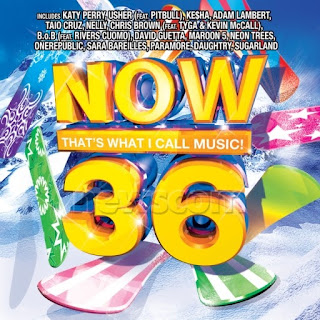
Elvis Track on New Now That's What I Call Music Vol. 36


“Now That’s What I Call Music! Vol. 36,” the latest in the never-ending collection of current pop hits, will street on Nov. 9 with a new feature.

A few editions back, “Now” added a “Now What’s Next” slot for tracks from emerging acts. Now, for the first time, the compilations will also include a “Now Flashback” track.  The first will be Elvis Presley’s “Suspicious Minds.”  And in what we’re sure is a total coincidence,  “Now 36” comes with info on how to enter a contest to win a trip to Vegas to see “Viva Elvis by Cirque du Soleil” at that Aria Hotel.

The “Now What’s Next” tracks from “36” come from The Secret Sisters, Sick Puppies, and Free Energy.

NOW That’s What I Call Music! Vol. 36  track listing:

1.  Katy Perry                                                          Teenage Dream
2.  Usher (feat. Pitbull)                                             DJ Got Us Fallin’ In Love
3.  Ke$ha                                                                 Take It Off
4.  Adam Lambert                                                    If I Had You
5.  Taio Cruz                                                            Dynamite
6.  Nelly                                                                   Just A Dream
7.  Chris Brown (feat. Tyga & Kevin McCall)           Deuces
8.  B.o.B (feat. Rivers Cuomo)                                Magic
9.  David Guetta                                                      Memories (feat. Kid Cudi)
10. Maroon 5                                                           Misery
11. Neon Trees                                                        Animal
12. OneRepublic                                                      Secrets
13. Sara Bareilles                                                    King Of Anything
14. Paramore                                                           The Only Exception
15. Daughtry                                                            September
16. Sugarland                                                          Stuck Like Glue

BONUS TRACKS: “NOW What’s Next” New Music Preview
17. Sick Puppies                                                     Maybe
18. Free Energy                                                      Bang Pop
19. The Secret Sisters                                           Tennessee Me
BONUS TRACK: “NOW Flashback”
Elvis Presley                                                           Suspicious Minds

Source: INC

Music City Walk of Fame Announces Inductees

Music City Walk of Fame Presented by Gibson Guitar Announces Inductees: Eddy Arnold, Little Jimmy Dickens, Bobby Hebb, Kris Kristofferson, Rascal Flatts and Mel Till
The eighth class of inductees to the Music City Walk of Fame will be recognized officially with the unveiling of commemorative sidewalk markers on Sunday, Nov. 7, beginning at 2 p.m. in Walk of Fame Park in downtown Nashville.
We are pleased to honor this amazing class of inductees Nashville, TN (Vocus) October 28, 2010
Music City, Inc. today announced the eighth class of inductees to the Music City Walk of Fame, presented by founding sponsor Gibson Guitar: Eddy Arnold, Little Jimmy Dickens, Bobby Hebb, Kris Kristofferson, Rascal Flatts and Mel Tillis. The honorees will be recognized officially with the unveiling of commemorative sidewalk markers on Sunday, Nov. 7, beginning at 2 p.m. in Walk of Fame Park in downtown Nashville. The induction ceremony, which is sponsored by Great American Country (GAC), is free and open to the public.
The Music City Walk of Fame is an official project of Music City, Inc., the charitable foundation of the Nashville Convention & Visitors Bureau (NCVB), and is produced with the support of presenting sponsor Gibson Guitar and sponsors GAC, the City of Nashville and Metro Parks.
“We are pleased to honor this amazing class of inductees,” said Butch Spyridon, president of the Nashville Convention & Visitors Bureau. “Each honoree represents the immense talent, creativity and diversity that have made Nashville, Music City.”
Created in the fall of 2006, the Music City Walk of Fame, on Nashville’s Music Mile, is a landmark tribute to those from all genres of music who have made significant contributions to preserving the musical heritage of Nashville and have contributed to the world through song or other industry collaboration. With the induction of this new class of honorees, there will be 48 total stars along the Walk of Fame.
Permanent sidewalk medallions made of stainless steel and terrazzo, with each honoree’s name displayed in a star-and-guitar design, will be installed in the sidewalk along the Music Mile. The plaques for this class of inductees will be inlaid in Hall of Fame Park on Demonbreun, between 4th and 5th Avenues South.
Nominations were open to the public and accepted in the categories of Artist, Musician, Songwriter, and Producer/Music Industry Executive. Application forms were reviewed by the Music City Walk of Fame anonymous selection committee.
“Gibson Guitar is honored to continue the tradition of the Music City Walk of Fame which celebrates the vast wealth of talent and creativity that originates in Nashville,” said Henry Juszkiewicz, Chairman and CEO of Gibson Guitar. “This class of inductees is no exception. From our own signature artist Kris Kristofferson to Rascal Flatts along with Little Jimmy Dickens, Bobby Hebb, Eddy Arnold and Mel Tillis, this exceptional group of artists keep Nashville’s place in music history strong.”
The November inductees for the Music City Walk of Fame:
Eddy Arnold Eddy Arnold, one of the greatest singers in both country and pop genres, was born May 15, 1918 in Chester County, Tennessee. On his eleventh birthday, his father died; later that year the farm the family lived on was auctioned off and the family became sharecroppers on the farm they once owned. Arnold went to school through the ninth grade, then landed a job with a funeral home while he sang on the local radio station. Soon, he moved to Memphis, then St. Louis where he appeared on radio for several years before landing a job with Pee Wee King and the Golden West Cowboys.
During World War II Arnold toured all over the United States with the Camel Caravan, appearing at Armed Forces bases. After the tour, he embarked on a solo career with the Grand Ole Opry, with the moniker, “The Tennessee Plowboy” and was signed to host the show sponsored by Purina on the NBC network. In December, 1944, Arnold, already a star on the Grand Ole Opry, made his first recordings for Victor Records at the WSM Studios - the first recording session by a major label in Nashville.
In 1945, he joined forces with Colonel Tom Parker, who was his manager for the next eight years. During that time, Arnold had a string of #1 hits, and in 1947-1948, he had the #1 song on the country charts for 60 consecutive weeks. In fact, in 1948 he outsold the entire pop division of RCA Victor which helped persuade RCA Victor as well as other notable record companies to eventually invest in building and operating recording facilities in Nashville.
Despite his roots as a sharecropper, Arnold never employed the traditional “nasal” twang long associated with country artist of his time. His musical influences included Bing Crosby and Gene Autry, therefore Arnold’s smooth baritone lent itself more to crooning which helped him cross over into the pop genre and gain favor with non-country audiences. That smooth style has never been paralleled in country music ever since.
During the 1950s Eddy Arnold became the first country artist to host a network prime time television show when he became the summer replacement for “The Perry Como Show.” He also hosted a national network radio show, “The Checkerboard Jamboree” for CBS and starred in two movies for Columbia Pictures, “Feudin' Rhythm” and “Hoedown”. Arnold became a major concert draw outside of the south during the late 1940s, and in 1952 “The Eddy Arnold Show” aired as a summer replacement show for Dinah Shore's variety show on CBS. His theme song was “Cattle Call,” and he recorded it four different times. The 1955 version with the Hugo Winterhalter Orchestra was a number one record. Also, in 1955 he recorded the song “You Don’t Know Me”, a song he co-wrote with legendary songwriter, Cindy Walker. That song was made a standard by Ray Charles and has been covered by artists as diverse as Elvis Presley and Bob Dylan. Most recently it was recorded by Michael Bublé and Willie Nelson.
Despite a career downturn in the late 1950s and early 1960s, Eddy reemerged as a leading figure in the famed “Nashville Sound” movement which brought a more refined touch to country music and expanded its audience therefore giving it more mainstream appeal. In 1965, he scored his biggest hit of all, “Make The World Go Away”, a record that is now in the Grammy Hall of Fame. In 1966 he was elected to the Country Music Hall of Fame, and in 1967 he became the first person to win the Entertainer of the Year honor from the Country Music Association.
Eddy Arnold sold over 85 million records and is the only country artist to have charted records in seven different decades, one of which was a duet version of “Cattle Call” with LeAnn Rimes from her “Blue” album that was released by Curb Records in 1996. In 2000, he received the National Medal of the Arts from President Bill Clinton and was awarded a “Lifetime Achievement Grammy” in 2005. Eddy Arnold died on May 8th, 2008, thus silencing an unmistakable voice that inspired generations of singers and millions of fans alike.
Following his death in May 2008, RCA Records released the single “To Life”, a song from the album “After All These Years” and it debuted at No. 49 on the Hot Country Songs charts, which was his first entry into that particular chart in 25 years. Because of this feat, he also became the oldest artist to chart Billboard and it also set the record for the longest span between an artist’s first chart single and the last: 62 years and 11 months (“Each Minute Seems Like a Million Years” debuted on June 30, 1945), and extended Arnold's career chart history to seven decades.
Little Jimmy Dickens Born in Bolt, West Virginia, Dickens began his musical career in the late 1930s, performing on a local radio station while attending West Virginia University. He soon quit school to pursue a full-time music career, and traveled the country performing on various local radio stations under the name “Jimmy the Kid.”
In 1948, Dickens was heard performing on a radio station in Saginaw, Michigan by Roy Acuff, who introduced him to Art Satherly at Columbia Records and officials from the Grand Ole Opry. Dickens signed with Columbia in September and joined the Opry in August. Around this time he began using the nickname, Little Jimmy Dickens, inspired by his short stature.
Dickens recorded many novelty songs for Columbia, including “Country Boy,” “A-Sleeping at the Foot of the Bed” and “I'm Little But I'm Loud.” His song “Take an Old Cold Tater (And Wait)” inspired Hank Williams to nickname him “Tater”. Later, telling Jimmy he needed a hit, Williams penned “Hey Good Lookin'“ specifically for Dickens in only 20 minutes while on a Grand Ole Opry tour bus. A week later Williams cut the song himself, jokingly telling him, “That song's too good for you!”
In 1950, Dickens formed the Country Boys with musicians Jabbo Arrington, Grady Martin, Bob Moore and Thumbs Carllile. It was during this time that he discovered future Hall of Famer Marty Robbins at a television station while on tour with the Grand Ole Opry road show. In 1957, Dickens left the Grand Ole Opry to tour with the Philip Morris Country Music Show.
In 1962, Dickens released “The Violet and the Rose,” his first top 10 single in 12 years. Two years later he became the first country artist to circle the globe while on tour. He also made numerous TV appearances including The Tonight Show with Johnny Carson. In 1965, he released his biggest hit, “May the Bird of Paradise Fly Up Your Nose,” reaching number one on the country chart and number 15 on the pop chart.
In the late 1960s, he left Columbia for Decca Records, before moving again to United Artists in 1971. That same year he married his wife, Mona. He returned to the Grand Ole Opry in 1975, and was inducted into the Country Music Hall of Fame a few years later.
He joined producers Randall Franks and Alan Autry for the In the Heat of the Night cast CD “Christmas Time’s A Comin’” performing “Jingle Bells” with the cast on the CD released on Sonlite and MGM/UA for one of the most popular Christmas releases of 1991 and 1992 with Southern retailers.
Recently, Dickens has made appearances in a number of music videos by fellow country musician and West Virginia native Brad Paisley. He has also been featured on several of Paisley's albums in bonus comedy tracks along with other Opry mainstays such as George Jones and Bill Anderson. They are collectively referred to as the Kung-Pao Buckaroos.
With the passing of Hank Locklin in March 2009, Dickens is now the oldest living member of the Grand Ole Opry at the age of 89. He still makes regular appearances as a host at the Opry.
Bobby Hebb Bobby Hebb made his stage debut on his third birthday, when tap dancer Hal Hebb introduced his little brother to show business at The Bijou Theater. This was an appearance on The Jerry Jackson Revue of 1942. Harold Hebb was nine years of age at the time and the young brothers worked quite a few nightclubs before Bobby entered first grade.
Nashville establishments like The Hollywood Palm, Eva Thompson Jones Dance Studio, The Paradise Club, and the basement bar in Prentice Alley, as well as the aforementioned Bijou Theater, found Bobby and Hal dancing and singing. Hebb's father, William, played trombone and guitar, his mother, Ovalla, played piano and guitar, while his grandfather was a chef/cook on the Dixie Flyer, an express train on the L&N -- Louisville & Nashville railroad.
Bobby, with so much musical influence and inspiration, would go on to pen hundreds upon hundreds of tunes, among them, BMI's number 25 most played song on their website in 2000, the classic “Sunny.” Georgie Fame and Cher, charted with the title in England, but it was Hebb’s original which reached the highest on charts in Europe and America. Covers by Frank Sinatra with Duke Ellington, Ella Fitzgerald, Stevie Wonder, Frankie Valli, Nancy Wilson, the Four Tops, Wilson Pickett, Dusty Springfield, and so many others, insured the song would reach audiences outside of those who heard and continue to hear it on Top 40 and “oldies” stations. The song reached beyond Top 40, climbing the country and R&B charts as well. Kal Rudman calls this a rare industry “hat trick” in the liner notes on the 1966 Phillips' album, but what no one could predict is how the song would find versions by Boney M. and Yambu bringing it to dance clubs, while jazz musicians explored the nuances of this amazing composition in their world.
Bobby Hebb's influence reaches far beyond “Sunny.” When he joined Roy Acuff's Smokey Mountain Boys around 1952, he was one of the first African American artists to perform on The Grand Ole Opry.
Around 1958 Bobby Hebb tracked “Night Train to Memphis,” a song written by Owen Bradley for Roy Acuff's Smokey Mountain Boys. The tune was re-released in 1998 on a Warner Bros. box set, From Where I Stand, which also included “A Satisfied Mind” from the 1966 Sunny album.
Hebb was represented by Buster Newman and his partner, Lloyd Greenfield, who managed Tom Jones and Engelbert Humperdinck. Bobby Hebb headlined a 1966 tour with the Beatles. After this, Hebb met comedian/composer Sandy Baron and the two got busy writing a Broadway show that never made it to Broadway. However, two of the songs -- “A Natural Man” and a tune they were writing about Marvin Gaye, “His Song Shall Be Sung” -- were picked up by Lou Rawls and released on MGM.
After a recording gap of thirty five years, Hebb recorded That's All I Wanna Know, his first commercial release since Love Games for Epic Records in 1970. It was released in Europe in late 2005 by Tuition, a pop indie label. New versions of “Sunny” were also issued. In October 2008, Hebb toured and played in Osaka and Tokyo, Japan.
Hebb continued to live in his hometown of Nashville until his death in August.
Kris Kristofferson A member of the Nashville Songwriters Hall of Fame, Kris Kristofferson helped rejuvenate Nashville's creative community in the late 1960s and early 1970s with the classics “Help Me Make It Through the Night,” “Me and Bobby McGee,” “For the Good Times” and “Lovin' Her Was Easier.” Hundreds of recording artists have performed his songs. As a concert performer, Kristofferson toured for many years, releasing numerous albums with his long-standing backup band, the Borderlords.
Kristofferson began his music career in the mid-60s when he ended scholarly pursuits in favor of songwriting. The son of an Air Force general, he was a Rhodes scholar, a helicopter pilot and might have been an English Lit professor at West Point, but he gave it all up for a shot at selling some of his songs. Encouraged by a meeting with Johnny Cash, he moved to Nashville in 1965. He pitched songs while working as a night janitor at Columbia studios, emptying ashtrays and pushing a broom.
His turning point came in 1969. Nashville was still the bastion of conservative country music, but a new generation of renegade writers and performers were bucking the establishment. Cash gave him his break by recording “Sunday Morning Coming Down,” which won the Country Music Association's song of the year trophy in 1970. Roger Miller sang “Me and Bobby McGee,” and Ray Price recorded “For the Good Times,” which won song of the year at the Academy of Country Music Awards in 1970.
He made his recording debut at the same time Janis Joplin's version of “Me and Bobby McGee” went to No. 1. Sammi Smith reached the national Top 10 with “Help Me Make It Through the Night,” which won the CMA's single of the year and a Grammy for best country song in 1971. Five subsequent albums, including The Silver-Tongued Devil and I and Jesus Was a Capricorn (which included the hit “Why Me”), went gold. His recordings with then-wife Rita Coolidge won the pair two Grammy awards. In 1973, “From the Bottle to the Bottom” was named best country vocal performance by a duo or group, and “Love Please” garnered the same award in 1975.
He started a movie career in 1971 when he co-starred with Gene Hackman and Harry Dean Stanton in Cisco Pike. He became an instant box-office draw, starring opposite such stars as Jane Fonda, Ellen Burstyn and Burt Reynolds. He also starred with Barbra Streisand in the classic film A Star Is Born in 1976. While making approximately two films a year, he continued to tour and record.
In the mid-80s, he joined Cash, Nelson and Waylon Jennings to form the Highwaymen. The supergroup's single, “Highwayman,” was named the ACM's single of the year for 1985. His 1990 solo album, Third World Warrior, demonstrated his concern for human freedoms. In 1999, he re-recorded some of his best-known tunes for The Austin Sessions, released on Atlantic Records. He teamed with Nelson, Jennings and Texas songwriter Billy Joe Shaver for Honky Tonk Heroes in 2000.
In the last decade, Kristofferson, who is signed with New West Records, has released two studio albums titled This Old Road and Closer To The Bone. This Old Road – Kristofferson's first recording in almost a dozen years – was hailed by critics as “one of the finest albums of his storied career” (Rolling Stone), “a stripped-down stunner” (Esquire), and “a return to his best work” (Q). Kristofferson also continues a vigorous schedule of national and international solo appearances, and he is currently filming a movie called A Dolphin Tale. The Americana Music Association presented him its 2003 Spirit of Americana Free Speech Award. In 2004, Kristofferson entered the Country Music Hall of Fame.
Rascal Flatts In just 10 years, Rascal Flatts has become one of the most honored acts in country music history, reaching heights and achieving milestones reserved for the genre's elite. They have set more venue attendance records than any country act en route to ticket sales of six million and counting. They have sold 20 million albums and earned 11 #1 singles. All six of their albums are platinum or multi-platinum and every one is among Billboard's Top 100 Albums of the Decade. They have won more than three dozen awards from the ACM, CMA, AMA and People's Choice, among others, and they have received that ultimate honor for those who have impacted the culture—a star on the Hollywood Walk of Fame. Behind those statistics is an accomplishment more basic than numbers, more important than any trophy—for the past decade, the music of Rascal Flatts has been the soundtrack to countless lives. Songs like “These Days,” “Mayberry,” “What Hurts The Most,” “My Wish,” “Stand,” “Here,” “Here Comes Goodbye” and “Summer Nights” have soothed and uplifted, fired up, mellowed out and otherwise impacted millions.
Their place in country music history may be assured, but Gary, Jay and Joe Don retain a newcomer's passion about capturing magic with each new project. Now, with the release of their latest, Nothing Like This, they have done it once again, taking their career and their legacy another long step forward. The album is a microcosm of all the things the band does well which is to say it touches on many of the best aspects of 21st-century country music. It is first and foremost uplifting, with songs like “Why Wait” and “Play” kicking off the proceedings with the call to enjoy life no matter what our circumstances. It features both the throwback groove of “They Try” and the fresh sparkle of “All Night To Get There.” “Summer Young” is an uptempo celebration of the season of warmth and romance and “I Won't Let Go” is “You've Got A Friend” for the new millennium, a song steeped in the strength of love and friendship in times of trouble. The title cut finds a way to bring freshness to the subject of love and sees Gary bringing a disarming desperation to his vocal. Evident throughout is the group's ability to recognize the best in Nashville songwriting.
The fact that they were able to do so reflects the magic they have always found in their approach to music and the respect with which they view their mission and each other. Their sound took root in the late 1990s, when Jay and Joe Don were band mates working with Chely Wright and Jay and Gary were playing a separate gig in downtown Nashville. When their guitar player was unable to make it one night, Jay asked Joe Don to sit in. The three honed their sound with club work, cut some demos and by year's end had been signed to Lyric Street Records, where they flourished and took off on that magical decade of hits and sold-out shows.
Along the way, their “Bless The Broken Road” was Grammy nominated for Country Song of the Year and Vocal Performance, they became 2006's top-selling physical and digital artist in all genres, scored four #1 country albums and three #1’s overall, and hit the Top 10 Billboard pop singles chart twice, among many other milestones. When Lyric Street closed its doors, they chose Big Machine as their new label home.
Committed to giving back, they are known for their charitable work, which includes raising three million dollars for the Monroe Carell Jr. Children’s Hospital at Vanderbilt in Nashville.
Never content to rest on their laurels, they are eagerly looking forward.
Mel Tillis Country music legend, Mel Tillis learned to play the guitar as a child, and in high school studied both the violin and the drums. Following high school, he entered the military and was stationed in Okinawa, Japan as a baker in the United States Air Force. During his time in the military, Tillis formed a band called The Westerners which played local clubs.
After leaving the military, Tillis moved to Nashville in 1956 to launch his musical career. In 1957, Webb Pierce took one of Tillis’ songs titled “I’m Tired” to number three on the charts. Tillis cut his first single that same year, a cover of “It Takes a Worried Man to Sing a Worried Song.” His first Top 40 hit came the following year with “The Violet and a Rose.”
Tillis continued to chart singles like 1959's “Finally” and a pair of duets with Bill Phillips, “Sawmill” and “Georgia Town Blues,” while also supplying Webb Pierce with hit after hit, including the 1959 smashes “I Ain't Never” and “No Love Have I” along with 1962's “Crazy Wild Desire” and 1963's “Sawmill.” Bobby Bare, Ray Price, Stonewall Jackson, and Little Jimmy Dickens also covered Tillis’ songs.
In 1965, Tillis recorded his first Top 15 hit, “Wine.” A string of successes followed, including 1966's “Stateside,” “Life Turned Her That Way,” and his first Top Ten, 1968's “Who's Julie.” At the same time, his stature as a songwriter continued to grow thanks to hit covers of his “Ruby, Don't Take Your Love to Town” by both Johnny Darrell and Kenny Rogers & the First Edition and “Mental Revenge” Waylon Jennings. After two 1969 Top Ten hits, “These Lonely Hands of Mine” and “She'll Be Hanging Around Somewhere,” Tillis scored back-to-back Top Five hits in 1970 with “Heart Over Mind” and “Heaven Everyday.” In 1971, he began a successful string of duets with Sherry Bryce which included “Take My Hand” and “Living and Learning.”
“I Ain't Never” became his first chart-topper in 1972. What followed was a series of Top Five smashes like “Neon Rose,” “Sawmill,” “Midnight, Me and the Blues,” “Stomp Them Grapes,” and “Memory Maker.” Between 1976 and 1980, he scored five more number ones -- “Good Woman Blues,” “Heart Healer,” “I Believe in You,” “Coca Cola Cowboy,” and “Southern Rains.”
In all, Mel Tillis has written well over 1,000 songs, with approximately 600 recorded by major artists. He has recorded more than 60 albums, including 36 Top Ten singles, with nine of them going to #1.
Mel has appeared in numerous feature films including “Every Which Way But Loose” with Clint Eastwood, “W.W. & The Dixie Dancekings” with Burt Reynolds and Jerry Reed, “Cannonball Run I and II,” “Smokey and the Bandit II” with Burt Reynolds, and the lead role with Roy Clark in “Uphill All The Way.” His most recent role was that of a plumber in Toby Keith’s 2008 movie “Beer For My Horses.”
In 1976, Tillis was inducted into the Nashville Songwriters International Hall of Fame, and that same year, he was named Country Music Association’s (CMA) Entertainer of the Year. Also, for six years in the 70’s, Mel Tillis won Comedian of the Year.
Mel Tillis became a member of the Grand Ole Opry in June 2007, and on October 28, 2007, he was inducted into the Country Music Hall of Fame
Mel Tillis has been in the music/entertainment business now for more than 50 years. He and his band, the Statesiders, have worked concerts all around the world, and continue to do so.
About the Nashville Convention & Visitors Bureau
The mission of the Nashville Convention & Visitors Bureau is to maximize the economic contribution of the convention and tourism industry to the community by developing and marketing Nashville as a premier destination. Visit the NCVB’s website at http://www.visitmusiccity.com/.
About Gibson Guitar
Gibson is known worldwide for producing classic models in every major style of fretted instrument, including acoustic and electric guitars, mandolins, and banjos. Gibson’s HD.6X-PRO Digital Guitar, the Gibson Robot Les Paul and the Gibson Dark Fire guitar represent the biggest advance in electric guitar design in over 70 years. Founded in 1894 in Kalamazoo, Michigan, and headquartered in Nashville since 1984, Gibson Guitar Corp.’s family of brands now includes Epiphone, Dobro, Maestro, Kramer, Steinberger, Tobias, Echoplex, Electar, Flatiron, Gibson Baldwin Music Education, Slingerland, Valley Arts, Oberheim, Sunshine Piano, Take Anywhere Technology, Baldwin, J&C Fischer, Chickering, Hamilton, and Wurlitzer. Visit Gibson’s website at http://www.gibson.com/ or http://www.gibson.com/press
About Great American Country
Great American Country is America’s main street for the widest variety of country music, its artists and the lifestyles they influence. In addition to country music videos, GAC features original programming, special musical performances and live concerts, and is the exclusive television home of the Grand Ole Opry. GAC is available in more than 44 million households and online at http://www.gactv.com/

Source: Press Release

A Piece Of Elvis' Hollywood Walk of Fame Star Placed In Capule

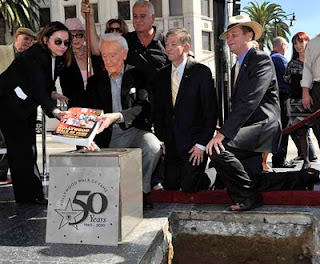
A time capsule commemorating 50 years of the Hollywood Walk of Fame was buried Thursday at Hollywood and Highland.
Actually, like many an entertainment industry event, the ceremony was mainly for show. The 16-by-16-by-18-inch, polished stainless steel, watertight cube will actually be interred today, and the final dedication takes place next Wednesday, when a party will be held for dozens of former honorees.
Thursday's lunchtime event, however, offered an opportunity to peruse the many items the capsule will contain before it's sealed four feet underground, below a specially designed sidewalk star. Plans call for the capsule to be dug up and opened in 2060.
"I'll be here," joked Ana Martinez-Holler, who's produced the Walk of Fame star ceremonies for the Hollywood Chamber of Commerce for 23 years. "My daughters are coming to open it. They've got it scheduled!"
Emceed by Hollywood Chamber of Commerce President and CEO Leron Gubler and retired "The Price Is Right" host Bob Barker, the capsule's unveiling kicks off the final stage of the world's glitziest sidewalk's golden anniversary.
As the star-studded Walk's specific date of origin was clouded by infighting and a couple of lawsuits back in the late 1950s and early '60s, the chamber - which sponsors and maintains the popular tourist attraction - decided to stretch out the anniversary events over a number of months.
"Although final construction was not completed until the spring of 1961, a celebration was held in November 1960 to mark the completion of the Walk of Fame," Gubler said. "We decided the most appropriate time would be to celebrate the Walk during the entire year of 2010 and to have an official celebration to mark the anniversary in November."
Among more than 50 items going into the capsule are a framed, autographed picture of Joanne Woodward, the first actor to pose beside her star (which is located on the northwest corner of Hollywood and Highland, next to the time capsule's square).
There's also a piece of Elvis Presley's star encased in Lucite; assorted DVDs of films, Oscar telecasts and greetings from star recipients; a script from "Casablanca"; a replica of the Capitol Records building; Pantages Theatre playbills for "The Lion King" and "Wicked"; and Emmy Awards memorabilia.
Also tucked in will be recent issues of the Los Angeles Daily News featuring articles about the Walk of Fame.
Barker contributed a handwritten note for posterity.
"It says, `Have your pet spayed or neutered'," the longtime animal rights activist explained with a smile. "I thought about it for a long time; I wanted something that was memorable, something profound.
"When my wife and I arrived here, we found an apartment just a couple of blocks south of Hollywood Boulevard," Barker continued. "And, of course, one of the first things we did was come up here to sightsee.
"I never dreamed that one day I would have a star on Hollywood Boulevard."
Barker's star was installed in front of the Egyptian Theatre in 1976.
The plaque that will go above the star will commemorate the original eight people who were honored with stars: Woodward, Olive Borden, Ronald Colman, Louise Fazenda, Preston Foster, Burt Lancaster, Edward Sedgwick and Ernest Torrence.
"We wanted to end the year with some sort of legacy project," Gubler said. "Our committee decided that nothing could be better than to install a time capsule at this location where it all began."

Source: Daily News

77 Trans Am Given To Vegas Limo Driver Being Restored


It was two years ago at a classic auto-parts trade show in Las Vegas that Jim Barber was approached by a father and son interested in restoring a 1977 Pontiac Trans Am.
He could tell by the conversation that the men had researched both his company — Classic Automotive Restoration Specialists in Belews Creek — and what their car needed.
“They were insistent that I look at the car right away. I went with them, and a limo pulled around to take us to the car,” Barber said.
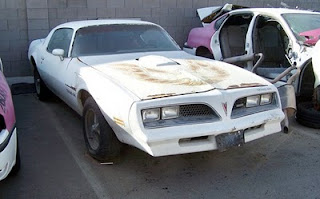
In the garage, Jason Awad — a Las Vegas lawyer — showed Barber a dingy, white second-generation Trans Am with damaged red seats and 82,000 miles on the odometer. The hood would not open, and the faulty brakes made the car unable to drive. The power window on the driver’s side would not close.
Barber knows from his line of work that every car has a story. He was wondering what it was with this one. Awad told him to look at the dash again.
So Barber ducked under the drooping headliner and started checking from left to right. He paused when he saw a brass plaque inserted into the red dash.
“Presented to my friend, Jason. Elvis. Oct. 1976.’’
“And then I got what was so special about this car,” Barber said.
‘Dear friend’
Awad had come to the United States from Israel for an education, and was working as a medical technician in a Las Vegas hospital. He also administered inhalation treatments for celebrities between their shows.
“They would get what is known as ‘the Vegas throat’ after their 6:30 shows and would need inhalation treatments before the 8 show,” Awad said in a telephone interview. “I got to know many celebrities, but Elvis became a dear friend.”
The men were so close that Elvis would have Awad meet him at the airport. Awad said Elvis would slip into his Datsun 240Z even though the car had dings and headlights that didn’t line up correctly. Awad thinks his famous friend liked being with him because he felt anonymous.
Elvis even on occasion stayed with Awad and his cousin, a Las Vegas doctor.
One night in October 1976, Elvis asked Awad for car advice.
“He said to me, ‘Jace, I need to buy a car for a friend.’ I told him to describe his friend to me. He said, ‘He’s a nice young man who likes to have a good time.’”
Awad recommended the new Pontiac Trans Am, a car known for muscle and speed. He said that Elvis picked up a phone and called the Pat Clark Pontiac dealership, even though it was 2 a.m.
“The phone rang and rang until a cleaning person picked up the phone and said, ‘You know we’re closed.… He couldn’t believe it was really Elvis so he invited him over … to see. The guy came and saw it was true and called the sales manager. Elvis told the sales manager he wanted the newest Trans Am right away,” Awad said.
The sales manager hesitated because he was not allowed to sell the 1977 model yet. Elvis persuaded him to sell the car off the showroom floor.
Awad said they drove away in the new car and stopped at a gas station to fill up.
“The attendant saw who was driving the car and gas spilled all over the new car. Elvis gave him $100, and we drove to Palm Springs. We were flying. There were no speed limits at the time, and then we came back.
“When we got back, Elvis said, ‘Jace, you like it? It’s yours.’”
Finding the right man
Ten months after he presented the Trans Am to Awad, Elvis died, on Aug. 16, 1977.
Not long after, Awad switched from his ambition of becoming a physician to becoming a lawyer. He drove his car to San Diego, where he attended law school. As he achieved success as a lawyer in Las Vegas, he kept the car in a garage.
His son, Ryan, pushed him to have the car restored.
They did some research to find the right person, which brought them to Barber.
Barber had grown up in Pennsylvania spending hours with his father tinkering with cars as a hobby. He wound up as a salesman for Eaton, a company that makes automotive parts and components for commercial, regular and classic vehicles. In 1999, he decided to open his own business, first in Walnut Cove, and then moving into his current building, once a former indoor riding arena for Arabia horses.
The car has been housed at Barber’s shop since January 2009, and every part — right down to every nut and bolt — painstakingly restored. Typical restoration jobs take 12 to 14 months, Barber said. This one went longer because Awad wanted everything kept as original as possible.
Today, the Pontiac 400-cubic-inch engine with its four-barrel carburetor and 350 Turbo-hydramatic transmission gleam as if never driven. The AM stereo with its console-mounted eight-track player is the same as when Elvis first purchased the car. Barber’s team embellished the car with the outstretched wings of the giant Trans Am phoenix on the cameo white hood. The “desert cooling system,” vital for Las Vegas’ climate, is ready to return to the heat.
Barber went so far as to track down the window sticker — it sold for $6,165.47 — from the now defunct Pat Clark Pontiac dealership. Barber talked with the son of Pat Clark, who told him that the story of Elvis buying the car was retold many times at the dealership.
‘The car is priceless’
Awad plans to give the car to “someone who understands,” and thinks it will end up going to the museum in the Las Vegas Hilton, where some of Elvis’ most famous shows were held. Car experts speculate that the car may be worth as much as $2 million.
The restoration topped $100,000. To Awad, the car cannot be assigned a monetary value. This weekend, he’ll see it restored for the first time.
“I get tears in my eyes when I think about that night and Elvis giving me that car. He was a Santa Claus for many people,’’ Awad said.
“He was one of a kind, and I met them all. He was kind and genuine and didn’t say anything mean to anyone. A lot of people took advantage of him, but I never asked him for anything.
“For me, this car is priceless. It may have been the last car he bought.”

Source: Winston Journal